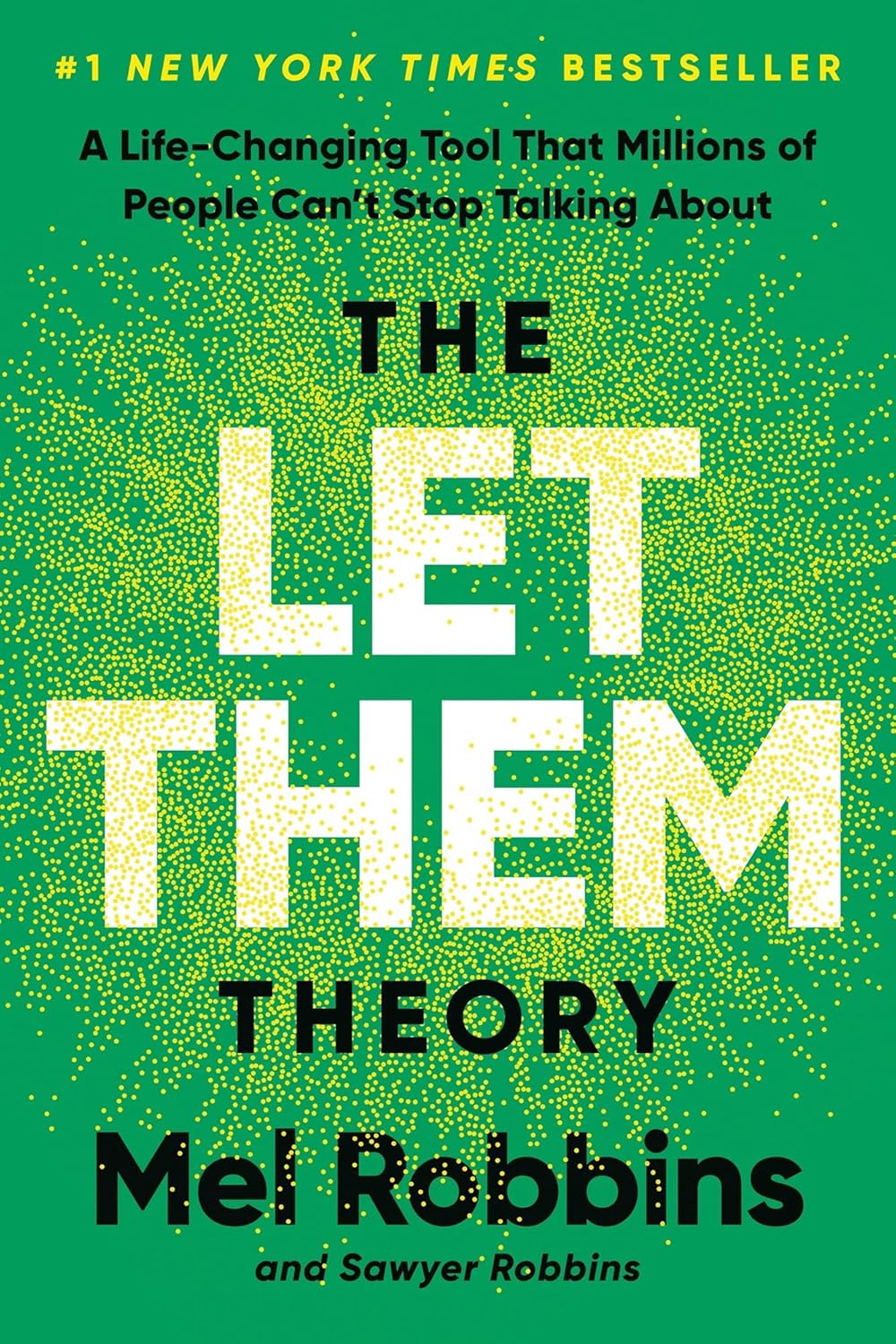
The Let Them Theory: A Life-Changing Tool That Millions of People Can't Stop Talking About
| Published | 2024-12-24 |
| Series | Standalone |
| Genre | Self-Help, Personal Development |
| Language | English |
| Publisher | Hay House LLC |
| ISBN-10 | 1401971369 |
| ISBN-13 | 978-1401971366 |
📝Honest Review
The theory itself is not new. The Stoics were writing about the distinction between what is and is not within our control roughly two thousand years ago. Epictetus, Marcus Aurelius, various Buddhist traditions, modern acceptance and commitment therapy, the entire philosophical lineage of radical acceptance, all of it points in the same direction that Mel Robbins is pointing. She knows this. The book acknowledges it. And yet the framing she and Sawyer have found, the two-word distillation of an ancient idea into something you can actually say to yourself in a moment of rising frustration, is genuinely clever in the way that good communication is always clever. It takes something complex and compresses it into a form small enough to carry with you.
The "Let Them" part of the theory is the first move, and it is about releasing your grip on other people's behavior. But Robbins is clear that this alone is incomplete, even potentially passive or dismissive if left there. The second move is the "Let Me," which is where the real weight of the book sits. Let them do what they do. Let me decide how I respond. Let me choose where I put my attention. Let me take the action that is actually within my control. The pairing of the two halves is what gives the framework its usefulness, because one without the other is either resignation or narcissism, and together they describe something more honest and more actionable.
The book is written with the warm, direct, conversational energy that Mel Robbins has always brought to her podcast and her public speaking. She does not write like an academic. She writes like the most honest person you know sitting across from you at a table and refusing to let you off the hook. There are personal stories, some of which are quite raw, about her marriage, her relationships with her children, professional disappointments, and the years she spent exhausting herself trying to manage outcomes that were never hers to manage. These stories work. They ground the abstract framework in lived experience in ways that make it feel real rather than theoretical.
The eight areas of application the book covers, including relationships, friendships, parenting, dating, work, and personal goals, give it a breadth that makes it feel comprehensive rather than narrow. This is not a book about one kind of problem. It is an attempt to show that the same fundamental misallocation of energy shows up in almost every area of most people's lives, and that the correction is always structurally the same even when the specifics differ enormously.
Where the book is less convincing is in its handling of nuance. The Let Them framework, applied without careful thought, can slide into justifications for disengagement or emotional withdrawal that are not always healthy or appropriate. Robbins addresses this, but not always with the depth the complication deserves. There are situations where other people's behavior absolutely does require a response, where letting them do what they are doing is not wisdom but avoidance, and the book's treatment of these edge cases is sometimes lighter than it should be. The framework is a tool, not a universal solution, and the most valuable parts of the book are the ones where Robbins is explicit about that distinction.
The collaboration with Sawyer adds a generational texture that is genuinely useful. His perspective as a younger person navigating social media, evolving relationship norms, and a different set of cultural pressures than his mother grew up with gives certain chapters a depth they would not have had without that second voice. It is one of the things that makes this book feel slightly different from Robbins' previous work, more collaborative in its sensibility, less single-authored in tone.
This is, in the end, a book that does what it sets out to do. It takes an idea that matters, finds a memorable and transferable form for it, and supports that form with enough personal honesty, real research, and practical application that it earns the reader's time. The numbers it has sold are not an accident or a marketing miracle. They are the result of something genuinely useful arriving in a form that people can immediately use. That is harder to achieve than it looks.
Summary:
The Let Them Theory is built around two words that sound almost too simple to matter: Let Them. Let them gossip about you. Let them cancel plans. Let them disagree with your choices. Let them be disappointed. The idea is that the enormous amount of mental and emotional energy most of us spend trying to manage what other people think, feel, and do is energy that belongs to us and is being stolen, quietly and continuously, by our own compulsion to control things we were never meant to control. Mel Robbins, co-writing with her son Sawyer, argues that the moment you genuinely stop trying to manage other people's responses and redirect that energy back into your own life, something shifts in a way that is both immediate and lasting. The book walks through eight areas of life, from work and relationships to self-doubt and personal goals, and shows how the same two-word framework applies in each.
✅ What I Liked
The two-part structure of "Let Them" followed by "Let Me" is genuinely well-designed, avoiding the passivity that "let go" frameworks often fall into. The personal stories, especially those involving Robbins' marriage and her children, give the framework emotional weight rather than leaving it abstract. Sawyer's contribution adds a generational dimension that strengthens several chapters considerably. And the book's core argument, that most of us are hemorrhaging energy trying to manage things we cannot and should not control, is both true and underserved by most mainstream self-help.
❌ What Could Be Better
The framework's edge cases, the situations where letting them is genuinely the wrong response, are handled more briefly than they deserve. At over three hundred pages the book occasionally repeats its central argument in ways that feel padded rather than deepened. And readers already familiar with Stoic philosophy or acceptance-based therapy will recognize the ideas here as repackaged rather than genuinely new, which is not necessarily a flaw but is worth knowing going in.
Discover Your Next Great Read
Handpicked recommendations from our collection of literary treasures












💬Discussions