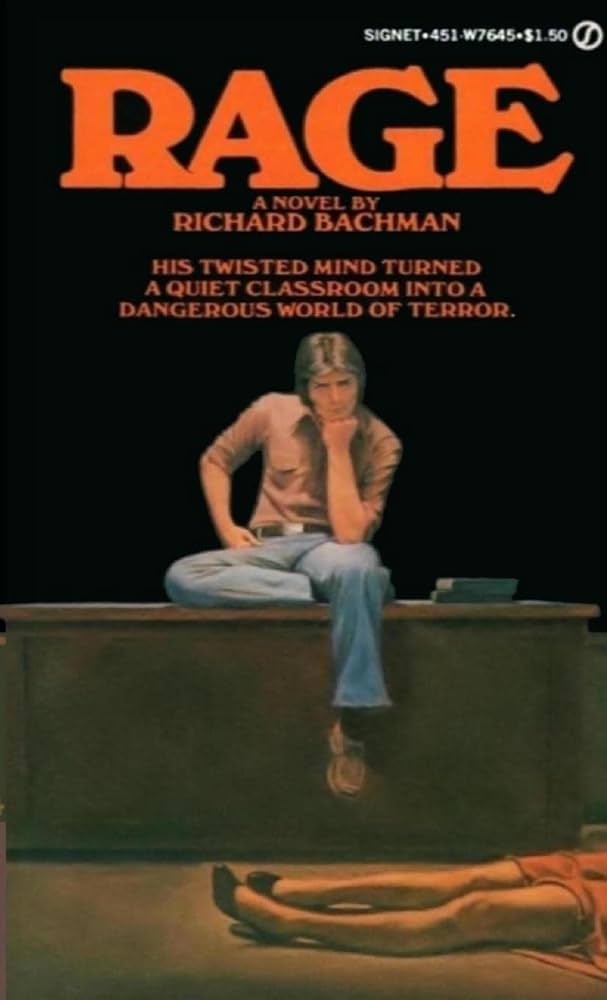
Rage
| Published | 1977-09-13 |
| Series | The Bachman Books (Book 1 of 4) |
| Genre | Psychological Thriller, Dark Fiction |
| Language | English |
| Publisher | Signet Books / New American Library |
| ISBN-10 | 0451076451 |
| ISBN-13 | 978-0451076458 |
📝Honest Review
With that said, Rage exists. It was written. It is in libraries. People read it and discuss it. And a review of it is not endorsement of school violence any more than a review of Crime and Punishment is endorsement of murder. So here is what it actually is, read as a piece of writing with the full weight of its context acknowledged.
King wrote the original draft of Rage as a teenager, under the title Getting It On, and it shows in ways that are both interesting and occasionally rough. It is the most personal of the Bachman novels, the one most visibly written from the inside of an adolescent experience rather than observed from a distance. Charlie Decker's voice is immediate and raw and sometimes uncomfortably recognizable, the voice of a young person who is furious at a world that seems organized around his humiliation and who has run out of ways to express that fury within acceptable limits.
What makes the book genuinely strange and genuinely interesting, even now, is what happens in the classroom after the initial violence. This is not a book about a shooting in any straightforward sense. The shooting happens quickly. What the book is actually about is the long afternoon that follows, in which Charlie holds court over his classmates and something unexpected begins to happen. The students, rather than maintaining terror and distance, start to engage with him. Old social hierarchies begin to dissolve. A boy who has been quietly terrifying a girl for months suddenly has that behavior named and examined in front of everyone. A kid who has never been able to say what he actually thinks about his own life starts talking. The class bully, the golden boy, the quiet girl at the back all find themselves in a room where the usual rules do not apply, and the results are deeply uncomfortable in ways that have nothing to do with the gun.
King is exploring something here about adolescent social dynamics, about the violence that happens constantly in high school corridors without weapons, about the way institutional authority requires a kind of performance of normality that damages the people required to perform it. Charlie's position as captor gives the other students permission to stop performing, and what comes out when they stop is not always what you would expect. Some of the classroom scenes are genuinely powerful, written with the kind of intuitive psychological accuracy that King was already capable of very early in his career.
The book also has real problems. The ending is rushed and not entirely convincing. Some of the supporting students are thinly drawn. And the central act of violence, while narrated with deliberate casualness rather than glorification, is still a piece of fiction that portrays a school shooter in a sympathetic first-person voice, which is why King eventually decided it had no right to keep circulating. That decision was correct. But the writing is real, and dismissing the book entirely because of what it was associated with does not quite account for what it actually is.
This is an early, flawed, genuinely unsettling piece of work by a writer who was already thinking seriously about things that most popular fiction preferred not to think about at all. It is not recommended as casual reading. It is not something you can locate easily or ethically recommend someone go out of their way to find. But if it crosses your path, you will find it more complicated and more interesting than its reputation, for good or ill, tends to suggest.
Summary:
Charlie Decker is a high school senior in Placerville, Maine, called to the principal's office one spring morning to discuss an incident two months earlier in which he put a pipe wrench through his chemistry teacher's skull. The meeting does not go well. Charlie is expelled. He walks back to his locker, retrieves a pistol, kills one teacher in the hallway and seriously wounds another, returns to his algebra classroom, locks the door, and holds his twenty classmates hostage for the remainder of the school day. What follows is not an action story and not a thriller in the conventional sense. It is a long, strange, claustrophobic afternoon in which Charlie talks, and his classmates gradually begin to talk back, and old secrets start surfacing, and something shifts in the room that nobody expected and nobody can quite explain.
✅ What I Liked
The classroom dynamic that develops after the initial violence is psychologically complex in ways that go well beyond what you would expect from a first novel written by a teenager. Charlie's voice is raw and immediate and occasionally brilliant. The scenes where the students begin to turn on each other and examine their own behavior have a real, uncomfortable honesty to them.
❌ What Could Be Better
The ending is underdeveloped and arrives too quickly after the sustained tension of the classroom sections. Some supporting characters exist mainly as types rather than people. And the first-person sympathy extended to a school shooter is the reason this book is no longer in print, which is not a reason to dismiss the writing entirely but is absolutely a reason to approach the book with serious caution and awareness of its real-world associations.
Discover Your Next Great Read
Handpicked recommendations from our collection of literary treasures
💬Discussions