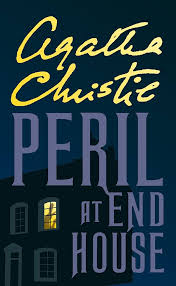
Peril at End House
| Published | 1932-02-01 |
| Series | Hercule Poirot Mysteries (Book 8 of 45) |
| Genre | Mystery, Fiction |
| Language | English |
| Publisher | Collins Crime Club (UK) |
| ISBN-10 | 0062074024 |
| ISBN-13 | 978-0062074027 |
📝Honest Review
Nick Buckley herself is one of Christie's more appealing heroines. She is not a passive victim waiting to be saved. She is sharp, funny, a little reckless, and entirely comfortable in her own skin, the kind of woman who has spent her whole life treating danger as an inconvenience rather than a catastrophe. Christie clearly enjoys writing her, and that enjoyment is infectious. You spend the first third of the book genuinely liking Nick, which turns out to be exactly what Christie needs you to do.
The Cornish setting is worth mentioning separately. End House itself, perched on the edge of a cliff, run-down, eccentric, full of family history and creaking timbers, is a magnificent backdrop. Christie gives it a personality almost as vivid as the characters who surround it. The cliffs, the sea, the small hotels and coastal paths of what Christie calls the Cornish Riviera all contribute to an atmosphere that is simultaneously sunny and unsettling, the kind of place where a bullet through a sun hat seems both shocking and somehow inevitable.
Hastings is more present and more useful in this novel than in many others, which is a genuine pleasure. His loyalty to Nick is immediate and uncomplicated, he is taken with her from the start, and his slight jealousy when other men show interest in her is written with Christie's characteristic light touch of humor. He is still intellectually outpaced by Poirot in every room they enter together, but here that gap feels affectionate rather than embarrassing, and his narration has a warmth to it that keeps the book from ever becoming cold or clinical.
The actual mechanics of the mystery are, upon reflection, among the most clever Christie ever devised. The central trick she plays on the reader is one of deceptive simplicity, the kind of thing that seems obvious in retrospect but genuinely blinds you while you are reading. She relies on an assumption so natural and so automatic that you make it without even realizing you have made it, which is precisely where she wants you. When Poirot finally explains everything, there is that characteristic Christie moment where you feel simultaneously impressed by her intelligence and mildly embarrassed by your own failure to see it.
That said, the book is not without its weaknesses. The supporting cast, the friends and guests who orbit Nick at End House, are a little underpopulated in terms of depth. Some of them exist more as suspects than as people, and a few of the red herrings are pursued a touch mechanically. There is also a subplot involving cocaine smuggling that feels slightly grafted on, a concession to the thriller conventions of the era that doesn't quite sit flush with the elegant puzzle underneath. These are real flaws, but they are minor ones against the overall quality of the construction.
What elevates Peril at End House above straightforward competence is Christie's confidence in her own central idea. She knows exactly what she is doing from the first page, she never overcorrects, and she trusts the reader enough to plant every clue in plain sight. That trust is itself a kind of authorial generosity. You have everything you need to solve this before Poirot does. The fact that you almost certainly won't is simply a testament to how well Christie has learned, by this point in her career, to make you look in entirely the wrong direction while smiling at you from the right one.
Summary:
Hercule Poirot and his loyal companion Captain Hastings are on holiday on the Cornish Riviera, doing absolutely nothing, which is, for Poirot, an almost unbearable condition. Relief arrives in the form of Nick Buckley, a bright young woman who owns the crumbling clifftop mansion known as End House. Nick mentions, almost casually, that she has had three near-escapes from death in the past few days, a brake failure on a mountain road, a falling boulder on a coastal path, a wasp sting that triggered an allergic reaction. She laughs it off as bad luck. Poirot does not laugh. He is certain someone is trying to kill her, and he is determined to stop them before the fourth attempt succeeds. What follows is one of Christie's most elegantly constructed misdirections, a puzzle in which Poirot is trying to prevent a murder rather than solve one, and where the truth, when it finally arrives, is both completely surprising and entirely fair.
✅ What I Liked
The premise of protecting a potential victim rather than solving an existing murder gives the book a momentum and urgency that many Christie novels don't have. Nick Buckley is a genuinely well-drawn heroine, spirited and believable in a way that Christie's female characters aren't always given room to be. The Cornish setting is atmospheric and vivid without ever becoming a postcard. The central deception is one of Christie's most elegant, built entirely on a reader assumption so natural it barely registers as an assumption at all. And the final revelation has that perfect Christie quality of being simultaneously a complete surprise and the only possible answer once you know it.
❌ What Could Be Better
Several of the secondary characters around Nick feel thin, present as suspects rather than people, which makes some of the red herrings feel obligatory rather than organic. The cocaine smuggling subplot is a period detail that doesn't integrate as smoothly as it should into the larger puzzle. And while Hastings' narration is warm and readable, his consistent failure to see what is directly in front of him can occasionally feel a little too convenient, a little too manufactured for the sake of keeping the reader equally in the dark.
Discover Your Next Great Read
Handpicked recommendations from our collection of literary treasures
💬Discussions