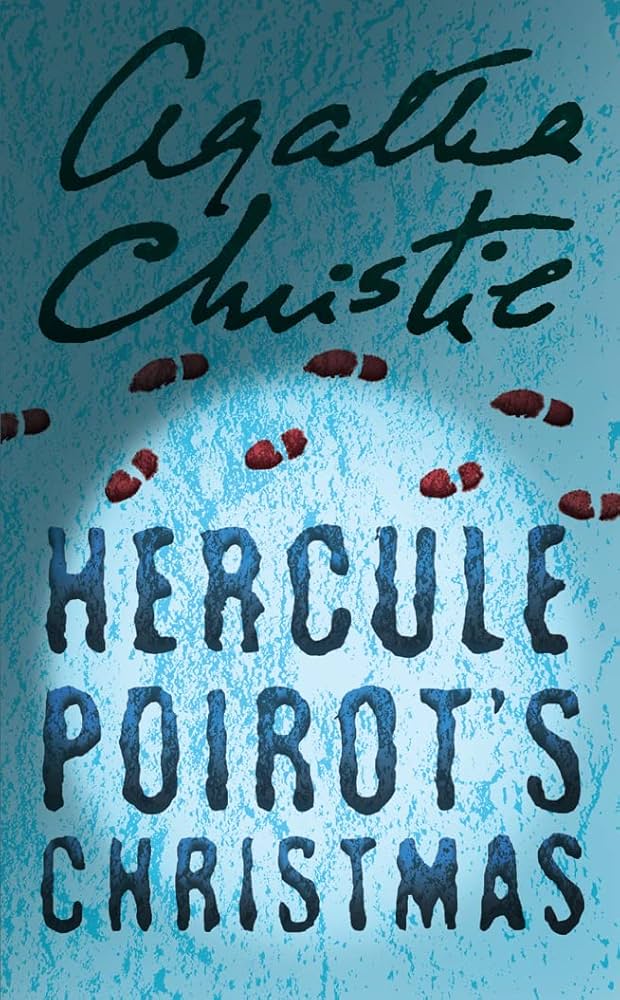
Hercule Poirot Christmas
| Published | 1938-12-19 |
| Series | Hercule Poirot Mysteries (Book 20 of 45) |
| Genre | Cozy Mystery, Locked Room Mystery |
| Language | English |
| Publisher | Collins Crime Club (UK) |
| ISBN-10 | 0425177416 |
| ISBN-13 | 978-0425177419 |
📝Honest Review
The book itself delivers exactly what was promised. This is one of Christie's bloodiest openings, and she doesn't flinch from it. But what makes Hercule Poirot's Christmas work as well as it does isn't the gore — it's the family. Simeon Lee is one of the great monsters of Christie's entire catalog. He is not a cartoon villain. He is something more recognizable and therefore more unsettling: a patriarch who uses money as a weapon, who keeps his children emotionally crippled by making them financially dependent, who summons them home not to celebrate but to remind them of exactly how much power he still holds over their lives. By the time he ends up dead on the floor, you have met every member of this household and understood, with uncomfortable clarity, why each of them might have done it.
Christie structures the family beautifully. The four sons are almost archetypes, the devoted one, the resentful one, the weak one, the prodigal, but she gives each of them enough specificity that they feel like actual people rather than suspect-shaped placeholders. Their wives add further texture. And then there is Pilar Estravados, Simeon's Spanish granddaughter who arrives uninvited and mysterious, bringing with her a whole separate layer of secrets that Christie uses to misdirect you very effectively.
The locked room element is handled with real craft. The question of how so much blood ended up in that room, far more than a human body should plausibly produce, is one of Christie's cleverest physical puzzles, and the answer, when it comes, is simple enough to feel fair and ingenious enough to feel surprising. That balance is harder to achieve than it looks, and Christie makes it look effortless here, which is the mark of someone who had been doing this for nearly twenty years by the time she wrote it.
Poirot himself is in fine form, though this is not one of his more showy performances. He moves quietly through the house, listens more than he speaks, notices the small things, and arrives at the truth through a process that feels genuinely earned rather than magically inspired. There's a moment late in the book where he explains exactly how he knew, laying out each small clue one by one, that is deeply satisfying in the way only the best golden age mysteries can be. You had all the information. It was all in front of you the whole time. You just didn't know how to look at it.
If I'm being honest, the book is not quite at the level of Christie's absolute peaks, Murder on the Orient Express, And Then There Were None, The Murder of Roger Ackroyd. The supporting characters outside the family, particularly the local police, are a little thin. And the pacing in the middle section, where Poirot conducts his interviews, can feel slightly mechanical if you've read enough Poirot to know the rhythm. But these are minor complaints against a book that does what it sets out to do with precision and confidence and just a little dark humor lurking beneath the festive trimmings.
As a Christmas mystery specifically, it earns its seasonal setting in a way a lot of holiday-themed crime fiction doesn't. The contrast between the warmth and goodwill the season is supposed to represent and the cold hatred festering inside Gorston Hall is not accidental, Christie is doing something deliberate with that tension. Christmas here is not a comfort. It's a pressure cooker. And when it finally blows, it does so in spectacular fashion.
Summary:
Tyrannical millionaire Simeon Lee summons his estranged family back to Gorston Hall for Christmas, not out of warmth or sentiment, but with deliberate cruelty in mind. He taunts his sons, threatens to rewrite his will, and makes it abundantly clear that he holds every one of them in contempt. Then, on Christmas Eve, a deafening crash and a blood-curdling scream ring out from his locked bedroom upstairs. When the door is forced open, Simeon Lee is found dead on the floor, his throat slashed, lying in a shocking amount of blood, far more than anyone can account for. Hercule Poirot, who happens to be staying nearby with a friend, is called in to investigate. He finds not a grieving family but a house full of suspects, every single one of whom had a perfectly good reason to want the old man dead.
✅ What I Liked
Simeon Lee is a villain of genuine psychological depth, he doesn't need supernatural powers to be frightening, which makes him more disturbing than most horror antagonists. The locked room puzzle is one of Christie's most cleverly constructed, and the physical clue at its center is both surprising and completely fair. The family dynamics are drawn with a sharp, unsentimental hand, there is real emotional truth in the way these damaged adult children orbit their monstrous father. The Christmas setting is used ironically and effectively, adding atmosphere and contrast without ever tipping into cliché. And the final reveal, as always with Christie, makes you want to immediately flip back to the beginning and read it all again with new eyes.
❌ What Could Be Better
The local police characters are largely forgettable and exist mainly to be wrong while Poirot is right, which is a function more than a characterization. The middle section of interviews can feel a little repetitive once you recognize the pattern, Poirot asks, someone lies, Poirot knows they're lying, moves on. A few of the secondary suspects are underdeveloped enough that when attention turns to them, you have to remind yourself who they are. And while the solution is clever, it depends on one detail that requires a fairly specific type of knowledge to piece together ahead of Poirot, without which, the clues that seem most significant are not quite the ones that matter most.
Discover Your Next Great Read
Handpicked recommendations from our collection of literary treasures

💬Discussions