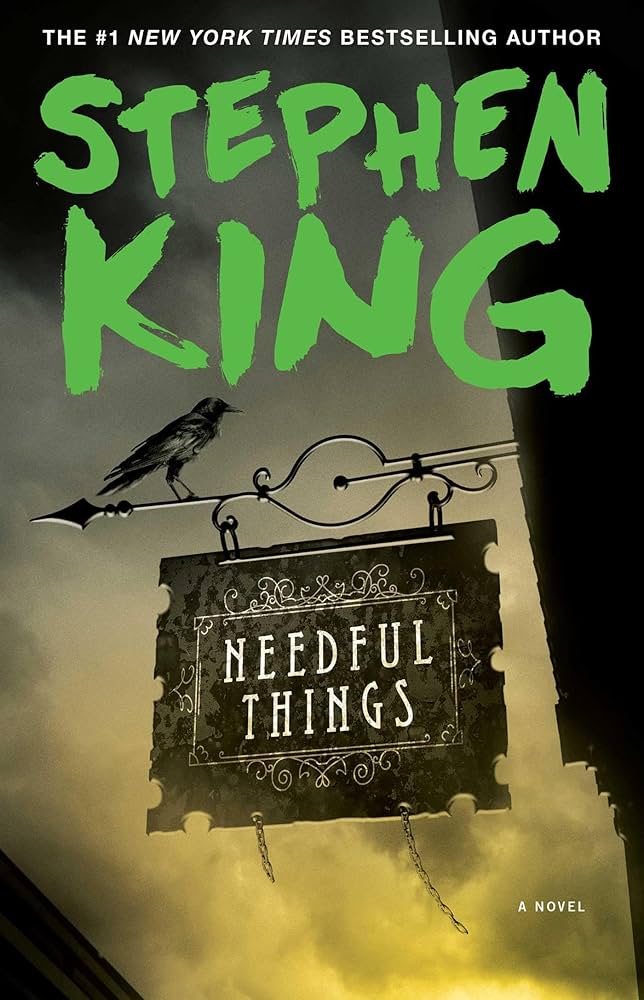
Needful Things
| Published | 1991-10-01 |
| Series | Castle Rock (Book — The Last Castle Rock Story) |
| Genre | Horror, Dark Fantasy |
| Language | English |
| Publisher | Viking (First Edition) |
| ISBN-10 | 0670839531 |
| ISBN-13 | 978-0670839537 |
📝Honest Review
The genius of the premise is how uncomfortably real it is. Leland Gaunt doesn't really do anything supernatural in the conventional sense. He doesn't turn into a monster. He doesn't cast spells. What he does is far more disturbing — he finds what people already want, gives it to them, and then uses their desire as a lever to pry apart everything holding their lives together. The horror in Needful Things isn't ghosts or demons. It's envy. It's resentment. It's the way a town full of perfectly decent people can burn itself down because someone gave them just the right nudge in just the right direction at just the right time. That's genuinely scary in a way that outlasts any jump scare.
King takes his time building this. The first 250 or so pages are almost completely free of violence. Instead, you get Castle Rock — the diner gossip, the political feuds, the Catholic-Baptist tensions, the old grudges everyone pretends they've forgotten. King is brilliant at this kind of slow accumulation. By the time you've been introduced to a dozen different characters and their petty little conflicts, you realize with a creeping dread that every single one of those conflicts is a fuse. And Gaunt has a match.
The cast is enormous — probably too enormous, honestly, and that is one of the book's real weaknesses. Some characters blur together because King simply doesn't have room for all of them to breathe. But the ones who do get space are excellent. Sheriff Alan Pangborn is one of King's finest protagonists — a decent, quiet, grieving man who is entirely out of his depth against something he cannot name or categorize, and who keeps showing up anyway because that's just who he is. Polly Chalmers, his girlfriend, gets a genuinely heartbreaking arc. And then there's Leland Gaunt himself — charming, patient, old in a way that has nothing to do with age, always smiling in a way that makes your skin prickle. He's one of the best villains King has ever written, which is saying something given the competition.
The third act is where the book goes absolutely berserk, and it is something to witness. Castle Rock doesn't just fall apart — it detonates. Neighbors murdering neighbors. Buildings burning. Decades of simmering small-town hatred boiling over all at once. It's chaotic and loud and almost operatic in scale, and King orchestrates it with real skill, cutting between storylines as everything converges. Some readers find it excessive. I found it earned — because King spent 600 pages making sure you understood exactly why these particular people would do exactly these particular things to each other.
Is this King's best book? No. The middle sags in places, and the sheer number of characters means some plotlines feel underdeveloped or rushed. But as an indictment of small-town groupthink, tribalism, and the human capacity for self-destruction — dressed up in the clothes of a supernatural horror novel — it's remarkable. And as a farewell to Castle Rock, the fictional Maine town King had been writing about since The Dead Zone in 1979, it's a fitting and brutal goodbye.
Summary:
A mysterious stranger named Leland Gaunt rolls into the small town of Castle Rock, Maine, and opens a curiosity shop called Needful Things. His shelves seem to hold the one thing each person in town has always secretly wanted — a rare baseball card for an eleven-year-old boy, an amulet for a woman crippled by arthritis, a keepsake for a grieving widow. The price is always reasonable. Some cash, and one small harmless prank to be played on a neighbor. It seems like nothing. But Gaunt is not what he appears to be, and the pranks are not harmless at all. One by one, old grudges crack open, suspicion turns to rage, and the perfectly ordinary people of Castle Rock begin destroying each other — while Gaunt watches, collects, and smiles. Sheriff Alan Pangborn is the only one who senses something is deeply wrong, and by the time he understands exactly what Gaunt is, Castle Rock is already tearing itself apart.
✅ What I Liked
Leland Gaunt is a genuinely terrifying villain precisely because he barely has to do anything — human greed and resentment do all the heavy lifting for him. The slow-burn first half, where King builds the town before destroying it, is patient and confident writing that most horror authors wouldn't dare attempt. Sheriff Pangborn is a deeply human protagonist whose quiet decency makes him compelling in a way that loudly heroic characters never are. The central idea — that desire itself is the real evil, and that we hand our autonomy over to anyone who promises us what we want — is a theme that has only become more relevant since 1991. The finale, for all its chaos, is genuinely spectacular.
❌ What Could Be Better
The sheer scale of the cast works against the book in its middle section — too many characters, too many subplots, and not enough page time for each one to feel fully realized. Some of the townspeople exist almost entirely as plot devices to escalate the chaos rather than as people you actually care about. The ending, while satisfying in terms of the Gaunt storyline, ties up a bit too neatly for a book that spent 700 pages showing how messy and irreversible real damage is. And if you haven't read the earlier Castle Rock books, some of the returning characters and references will fly completely over your head.
Discover Your Next Great Read
Handpicked recommendations from our collection of literary treasures
💬Discussions