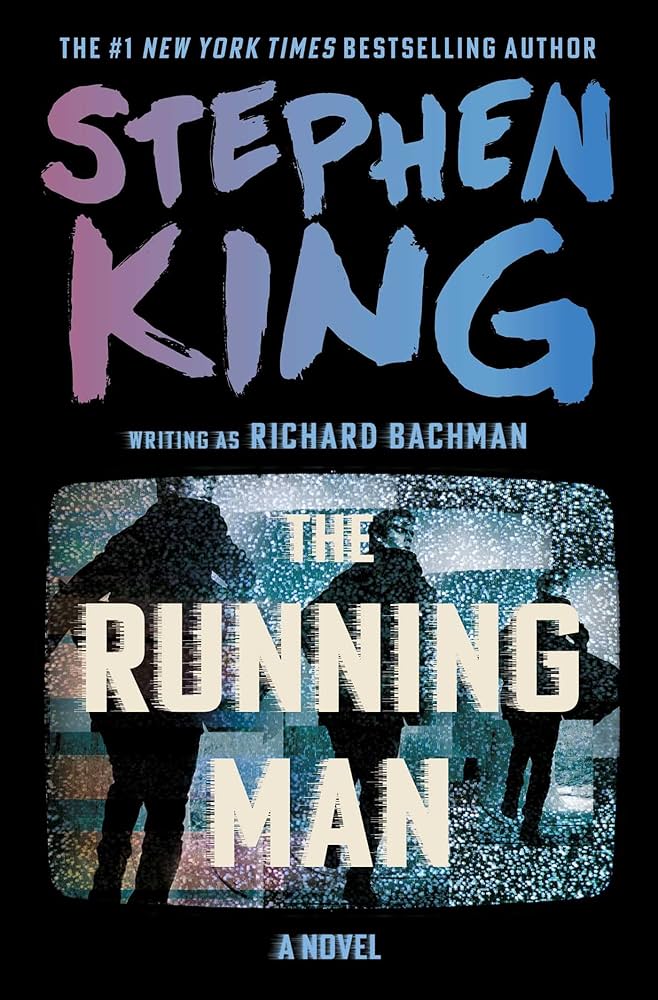
The Running Man
| Published | 1982-05-01 |
| Series | The Bachman Books |
| Genre | Dystopian Thriller, Science Fiction |
| Language | English |
| Publisher | Signet Books (original), Scribner (current edition) |
| ISBN-10 | 1501144510 |
| ISBN-13 | 978-1501144516 |
📝Honest Review
The premise of The Running Man is not subtle. It is a direct, unambiguous attack on television, on capitalism, on the way societies use entertainment to pacify populations who are being slowly destroyed by the systems they live inside. The Games Network exists not just to entertain but to distract, to redirect the anger of the poor away from the people responsible for their poverty and toward each other, toward contestants like Ben Richards who are simultaneously victims and spectacle. The audience cheers for Richards to be killed. The rich watch from their comfortable homes. The poor watch from their crumbling apartments because the Free-Vee, the government television system, is the one thing that has always been available for free. Christie does her thing with poison and locked rooms. King, writing as Bachman, does his thing with class warfare and institutional cruelty.
What makes the book work as a thriller rather than just a political pamphlet is Ben Richards himself. King establishes him in the first few pages with complete economy and devastating effect. His daughter is sick. His wife has been selling herself to afford milk. He sits in their apartment staring at the Free-Vee with the kind of empty concentration that comes from having run out of alternatives. By the time he walks into the Games Network studio there is no question of sympathy. You are entirely on his side, and King uses that allegiance ruthlessly.
The structure of the novel is one of its most distinctive features. Each chapter is titled with a countdown, starting at "Minus 100 and Counting" and working down to zero. It is a simple device and it should feel gimmicky. It does not. It gives the whole book the feeling of an inexorable clock, a tension that never quite releases even in the quieter moments between chases. King understood something very basic about thriller mechanics when he was in his twenties that some writers never figure out: the reader needs to feel the time running out, not just be told it is.
The world-building is spare and effective. King does not spend pages explaining his dystopia. He shows it in glimpses, in the pollution that coats the cities, in the casual acceptance of violence as entertainment, in the architecture of poverty that surrounds every scene where Richards is hiding or running. The 2025 of The Running Man is recognizable in the way only the best dystopian fiction manages, close enough to the present to be uncomfortable, different enough to still feel like fiction.
The ending is one of King's most audacious, most committed, and most memorable. He does not soften it. He does not look for a clever mechanical out that lets anyone escape consequence. He commits entirely to the logic of the situation he has built, and the result is something that lands like a punch and stays with you afterward. For a book written in a week by an angry twenty-five-year-old, that is an extraordinary achievement.
This is not King at his most technically accomplished. The novel has the rough edges you would expect from something produced at that speed. Some of the secondary characters are thin. The middle section, in which Richards is moving from city to city while managing to mail videotapes to the Network, is necessarily episodic and loses some momentum. But the anger that drives every page is real, and real anger, when it is this focused and this intelligent, produces something that technical polish alone never can.
Summary:
The year is 2025. America has collapsed into a totalitarian dystopia where the gap between rich and poor is not a social problem but a permanent, engineered condition. Ben Richards has no job, no money, a sick eighteen-month-old daughter who needs medicine he cannot afford, and no way out. In desperation he signs up for the Games Network, the government-sanctioned television system that broadcasts shows in which poor people risk their lives for cash. He qualifies for the top prize: The Running Man, where contestants are released into the world with a twelve-hour head start and then hunted by an elite team of professional killers called the Hunters. Every hour Richards stays alive, he earns a hundred dollars. Every Hunter or cop he kills earns him a hundred more. If he survives for thirty days, he wins one billion dollars. No contestant has ever lasted longer than eight days. The whole country watches. Nobody is rooting for Ben Richards.
✅ What I Liked
The class rage underneath the thriller plot is sharp, intelligent, and still entirely relevant. Ben Richards is one of King's most purely sympathetic protagonists. The countdown chapter structure creates a tension that never lets go. The ending is genuinely brave and completely uncompromising.
❌ What Could Be Better
The middle section loses momentum as Richards moves between cities. Some secondary characters exist mainly as plot mechanics rather than people. The political commentary, while pointed, is occasionally heavy-handed in a way that King's later, more disciplined work tends to avoid.
Discover Your Next Great Read
Handpicked recommendations from our collection of literary treasures


💬Discussions