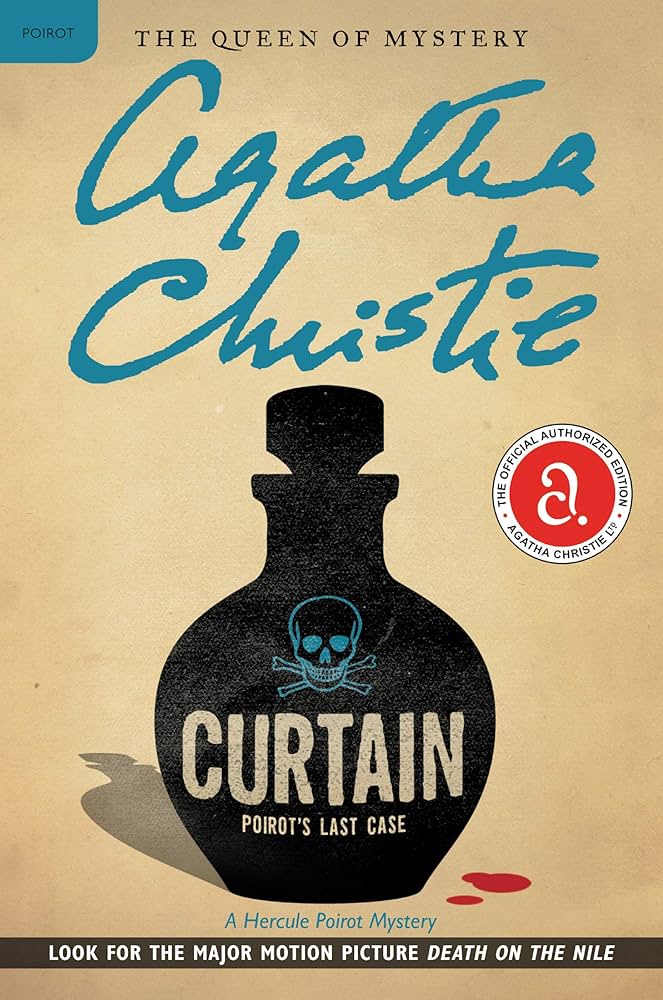
Curtain Poirots Last Case
| Published | 1975-09-01 |
| Series | Hercule Poirot Mysteries (Book 38 of 45) |
| Genre | Cozy Mystery, Crime Fiction |
| Language | English |
| Publisher | Collins Crime Club (UK) |
| ISBN-10 | 0062074091 |
| ISBN-13 | 978-0062074096 |
📝Honest Review
That backstory matters because it shapes the whole texture of the novel. Christie was not writing a puzzle when she wrote Curtain. She was writing an elegy, for Poirot, for Hastings, for Styles itself, for the entire golden age of detective fiction that she had done more than anyone else to create and define. And she was doing it while sitting in the rubble of a world that had just torn itself apart in a way that made genteel country house murders seem like a memory from another century.
The result is unlike any other book in the Poirot series. The mystery itself is genuinely ingenious, built around a concept so unsettling and so philosophically interesting that it could only work at the very end of a long series, when the reader knows Poirot well enough to feel the full weight of what Christie is asking him to do. The central idea is this: what do you do when you know with absolute certainty that someone is a murderer, has killed five people across different cases, and is about to kill again, but you have no evidence that any court in the world would accept? Poirot has spent his entire career answering that question with patience and process and trust in the law. In Curtain, for the first and only time, the law is not enough. And Poirot must decide, alone, what he is willing to do about it.
That moral weight is what elevates this book so far above most of Christie's work. It is not a comfortable read. Poirot does something in this novel that is genuinely shocking, something that forces you to reassess not just the plot but the entire character you thought you knew across forty-five books. Christie plants the clue for what he does quite openly, in a conversation that seems at the time like one of his usual philosophical tangents, and then she uses it. She commits to it fully. There is no softening of the consequences, no last-minute reprieve, no clever mechanical solution that lets everyone off the hook. The ending is devastating and earned and completely honest.
Hastings as narrator is more valuable here than he has been in many years. His limited understanding of what is actually happening around him, which in other Poirot novels can feel like a structural convenience, here becomes genuinely moving. He is watching his oldest friend and knowing something is wrong and being unable to name or fix it, which is one of the most recognizable experiences Christie ever wrote. His observations about Poirot's physical decline, about the way the great man sits in his chair and looks out windows and says less than he used to, are written with a tenderness that is completely unexpected from a writer who spent most of her career maintaining careful emotional distance from her characters.
The villain of this book is one of Christie's most genuinely chilling creations, not because of what they do but because of what they are. There is no melodrama, no theatrical evil. The danger is entirely psychological, entirely human, and entirely recognizable. And the way Christie reveals it, gradually and then all at once, is a masterclass in controlled disclosure.
This is not the book to read if you are new to Poirot. It requires the weight of the whole series behind it to land as it should. But for readers who have been with Poirot since the beginning, or even for a significant portion of his forty-five cases, Curtain is something close to essential. It is Christie at her most serious, her most morally courageous, and her most emotionally honest. She wrote it knowing she might not survive to publish it. That knowledge is on every page.
Summary:
Curtain brings Hercule Poirot and Captain Hastings back to Styles, the crumbling Essex country house where they solved their very first case together decades ago. But this is not a nostalgic reunion. Poirot is now wheelchair-bound, crippled with arthritis, his famous mustaches still immaculate but his body finally giving out beneath him. Hastings, older and widowed, arrives at Styles to find it converted into a guesthouse, filled with a collection of seemingly ordinary people. Poirot tells him, with complete calm, that one of the guests is a murderer, responsible for five deaths across different cases over the years, and that a sixth murder is coming. He needs Hastings to be his legs, his presence in rooms he can no longer reach. Hastings, as ever, does his best and understands almost nothing. What unfolds is the most unusual, most morally complex, and most devastating case of Poirot's entire career, and it ends in a way that no one who reads it ever quite forgets.
✅ What I Liked
The moral question at the heart of the novel is the most serious and most genuinely difficult thing Christie ever wrote. Poirot's final act is shocking, brave, and completely consistent with who he has always been, which makes it even more devastating. Hastings as narrator is at his warmest and most human. And the ending, including the letter Poirot leaves behind, is one of the finest pieces of writing in Christie's entire catalog.
❌ What Could Be Better
The identity of the killer, once revealed, requires a fairly specific kind of attention to spot in advance, and some of the Styles guest house characters feel slightly underdeveloped compared to Poirot and Hastings. Readers who have not read much of the series may also find the emotional payoff less powerful than those who arrive already familiar with both men.
Discover Your Next Great Read
Handpicked recommendations from our collection of literary treasures
💬Discussions