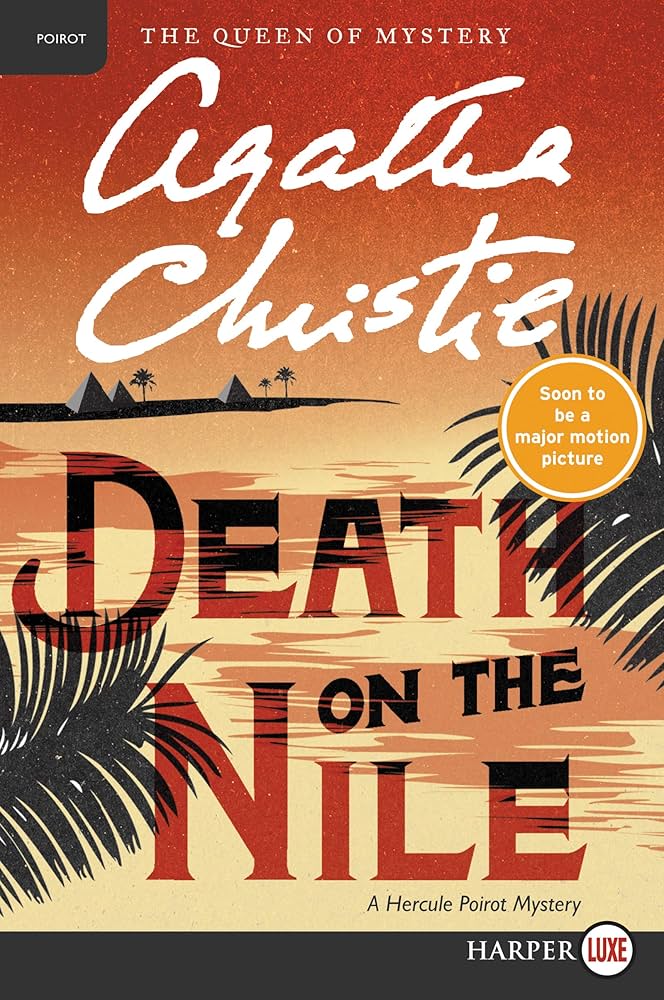
Death on the Nile
| Published | 1997-11-01 |
| Series | Hercule Poirot Mysteries (Book 17 of 45) |
| Genre | Cozy Mystery / Detective Fiction |
| Language | English |
| Publisher | Collins Crime Club (UK) |
| ISBN-10 | 0062073559 |
| ISBN-13 | 978-0062073556 |
📝Honest Review
The book is frequently described as one of Christie's best, and it is, though perhaps not for the reasons most people initially suppose. The Egyptian setting is gorgeous, yes. The cast of characters is large and vivid. Poirot is in sharp, engaged form. But what actually lifts Death on the Nile to the level of her finest work is something quieter and more emotionally resonant than any of those surface qualities: the love triangle at the heart of it is genuinely, achingly sad.
Jacqueline de Bellefort is one of Christie's most psychologically complete characters. She is not written as a villain, or at least not initially. She is written as a woman whose life has been organized around a man who chose someone else, and whose grief and humiliation and rage have nowhere to go because the social forms available to her do not accommodate the particular nature of what she has lost. She is too intelligent not to know that what she is doing, following the couple across Egypt, is damaging her own dignity as well as everyone else's peace. She does it anyway. Christie gives her enough interiority that her behavior never slides into simple menace. She is disturbing precisely because she is understandable.
Linnet, the victim, is less easily sympathetic, and Christie is entirely aware of that. She is a woman who has always gotten what she wanted and has therefore developed very little capacity for inhabiting the emotional reality of people around her. She did not set out to steal Simon from Jacqueline. She does not think of herself as having done anything wrong. That failure of imagination is drawn with cool, precise disapproval, and it makes the murder, when it comes, morally complicated in a way that straightforward villainy never could be.
The solution, when Poirot assembles it in the final act, is genuinely brilliant. The central alibi mechanism is as good as anything Christie ever constructed, and the way it depends on the reader having made a specific and entirely natural assumption is a textbook example of her method at its most elegant. Even for experienced Christie readers, the revelation carries a jolt. Even for those who have read it before, the explanation in reverse, walking back through the evidence and seeing how each piece was placed, is enormously satisfying.
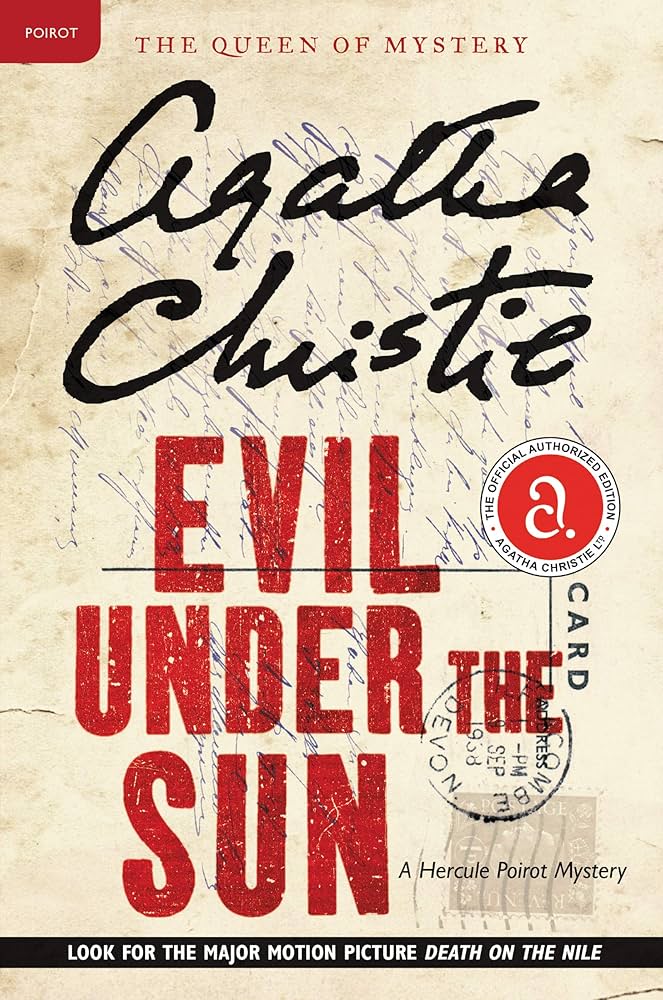
Robert Barnard, one of Christie's most astute critics, called the solution overcomplex, and there is a fair point there. The final explanation requires a level of coordination and planning that pushes against the edges of the plausible, a criticism that could equally be applied to Evil Under the Sun and several of her other masterworks. Christie's response, if she had one, was always essentially that the construction must be internally consistent and fair, and the reader must have had all the information needed to solve it. By those standards, Death on the Nile passes every test.
The supporting cast aboard the Karnak deserves specific mention because it is one of the richest Christie ever assembled. Colonel Race, the military man with intelligence connections, is a quiet and steady presence who complements Poirot without competing with him. The various other passengers, including an excitable romance novelist, a kleptomaniac American socialite, a Communist agitator, and a series of people with financial stakes in Linnet's will, are drawn with the quick, accurate characterization Christie could produce effortlessly by this point in her career. Each of them is a distinct individual. Each of them is a plausible suspect. And Christie manages to distribute your attention among all of them with a fairness that, in retrospect, seems almost impossibly controlled.
This is a book that earns its reputation entirely. It is one of the finest mysteries ever written, by one of the finest mystery writers who ever lived, at the absolute height of her considerable powers.
Summary:
Linnet Ridgeway has everything. She is young, beautiful, wealthy beyond most people's imagination, and has just married Simon Doyle, the man she loves. The only problem is that Simon was previously engaged to Jacqueline de Bellefort, Linnet's own close friend, and Jacqueline has not taken the end of that relationship gracefully. She follows the newlyweds to Egypt, appearing everywhere they go, watching them with an intensity that makes everyone around her deeply uncomfortable. Hercule Poirot, vacationing in Aswan, observes all of this from his deck chair with the particular attention he brings to everything, and privately warns Linnet that the situation has the feel of something that will not resolve itself peacefully. He is, as usual, correct. When Linnet is found shot through the head in her cabin aboard the Nile steamer Karnak, the obvious suspect has an alibi so airtight it seems impossible to challenge. Poirot must find the one arrangement of facts that actually accounts for everything he has seen and heard since coming aboard.
✅ What I Liked
Jacqueline de Bellefort is one of the most psychologically complete and genuinely moving characters in Christie's entire catalog. The central alibi is among the most brilliantly constructed in her career, fair, surprising, and completely satisfying once explained. The Egyptian setting has a vividness and authenticity that comes from direct experience rather than research. The large supporting cast is managed with Christie's most effortless skill, every character distinct and every one of them a plausible suspect right up to the end.
❌ What Could Be Better
The degree of coordination and physical precision required to execute the murder pushes against the edges of the plausible in ways that Christie's more intimate, small-cast mysteries do not. The very richness of the supporting cast, while a strength, also means that some of the more peripheral passengers are not developed quite far enough to feel fully real rather than ornamental.
Discover Your Next Great Read
Handpicked recommendations from our collection of literary treasures






💬Discussions