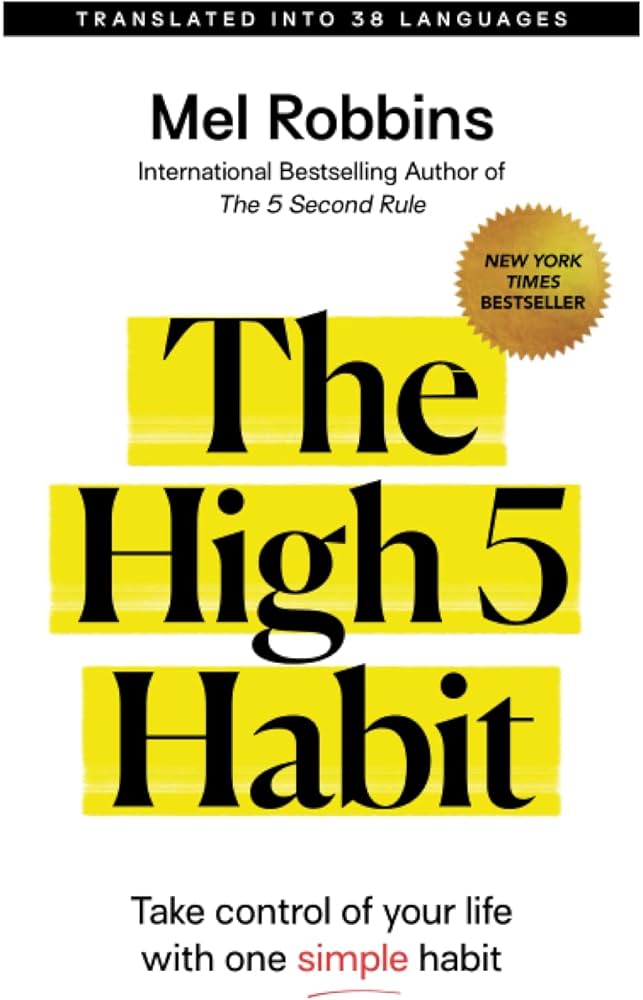
The High 5 Habit
| Published | 2001-09-28 |
| Series | Standalone |
| Genre | Self-Help, Personal Development |
| Language | English |
| Publisher | Hay House Inc. |
| ISBN-10 | 1401962122 |
📝Honest Review
Here's what she does that most self-help authors don't: she doesn't just tell you to feel better about yourself and leave you to figure out how. She explains, using actual neuroscience and behavioral psychology, why we feel so terrible about ourselves in the first place. The reticular activating system, the role of dopamine and serotonin in self-perception, the way our brains form associations with physical gestures and rituals, this is real science, explained in plain language without being dumbed down. The mirror high five isn't a gimmick. It's a deliberate use of behavioral conditioning, exploiting the fact that your brain already has a deep, hardwired association between a high five and the feeling of being celebrated. When you give it to yourself, you are, quite literally, training your brain to treat yourself as someone worth cheering for. Robbins doesn't ask you to just believe that. She shows you why it works.
What separates this book from the vast ocean of self-help content is Mel Robbins herself. She is not selling you a perfect life. She is not a polished guru speaking from some elevated position of having it all figured out. She talks openly about her own anxiety, her marriage hitting rock bottom, her persistent sense of not being good enough despite external success, the morning she stood in her bathroom unable to face the day and decided to try something different. That vulnerability is not performed, it feels genuinely raw in places, and it makes the book land differently than if it had been written by someone who presents themselves as already transformed.
She is also, frankly, very funny. There is a warmth and a self-deprecating humor running through the whole book that keeps it from ever becoming preachy or heavy. She is the friend who sits down with you over coffee and says look, I've been where you are, here's what I tried, here's what actually happened, which is a very different energy from the typical self-help author who writes as though delivering a sermon from on high.
The structure of the book is well thought out. She doesn't just introduce the habit and repeat herself for two hundred pages, which is a trap many self-help books fall into. She moves through the science, the personal stories, the practical application, and the broader philosophy of what it means to actually be on your own side, not in a narcissistic way, but in the way you'd naturally be on the side of someone you love. That reframe, what would you do for yourself if you treated yourself the way you treat the people you care about most, is simple and genuinely powerful, and it gets more sophisticated as the book progresses.
The weakest sections are the ones that feel most like worksheets, there are moments where the book slows into a sequence of exercises and journaling prompts that are probably more useful if you're actively working through the book rather than reading it cover to cover. And some readers who are already comfortable with the idea of self-compassion may find the early chapters covering ground they've already stood on. But these are minor complaints. The core of the book is solid, the science is sound without being dry, and the central argument, that the most important relationship you'll ever have is the one you have with yourself, and that most of us are neglecting it badly, is one that's worth sitting with regardless of how many self-help books you've already read.
I finished this book and actually tried the mirror high five the next morning. I felt slightly ridiculous for about two seconds. Then something unexpected happened. I'll leave it at that.
Summary:
The High 5 Habit is built around one deceptively simple idea: every morning, when you see yourself in the mirror, raise your hand and give your own reflection a high five. That's it. That's where it starts. But Mel Robbins, lawyer turned motivational powerhouse, uses that tiny physical gesture as the entry point into a much deeper conversation about why most of us are so much kinder to everyone else in our lives than we are to ourselves. The book is about self-talk, self-sabotage, the science behind why celebration and encouragement actually rewire the brain, and how the absence of genuine self-belief quietly undermines everything from your career to your relationships to your mental health. It is equal parts science, personal story, and practical challenge, and it hit the New York Times bestseller list immediately upon release.
✅ What I Liked
The science backing the central habit is genuinely interesting and well-explained, this is not a book asking you to take anything on faith. Mel Robbins' honesty about her own struggles makes the whole thing feel trustworthy in a way a lot of self-help writing does not. The writing is warm, funny, and conversational without being shallow. The core argument, that most of us extend far more grace and encouragement to others than to ourselves, and that this imbalance has real consequences, is both simple and genuinely thought-provoking. And unlike many books in this genre, it actually builds toward something rather than just repeating its central premise in different ways for two hundred pages.
❌ What Could Be Better
The journaling exercises and worksheet sections interrupt the reading flow and work better as a companion activity than as part of the book itself. Readers already well-versed in self-compassion literature may find the first third of the book covering familiar ground. There are also moments where the enthusiasm tips just slightly into the kind of relentless positivity that can feel exhausting if you're coming to the book from a low place, though Robbins is generally self-aware enough to pull back before it becomes overwhelming.
Discover Your Next Great Read
Handpicked recommendations from our collection of literary treasures








💬Discussions