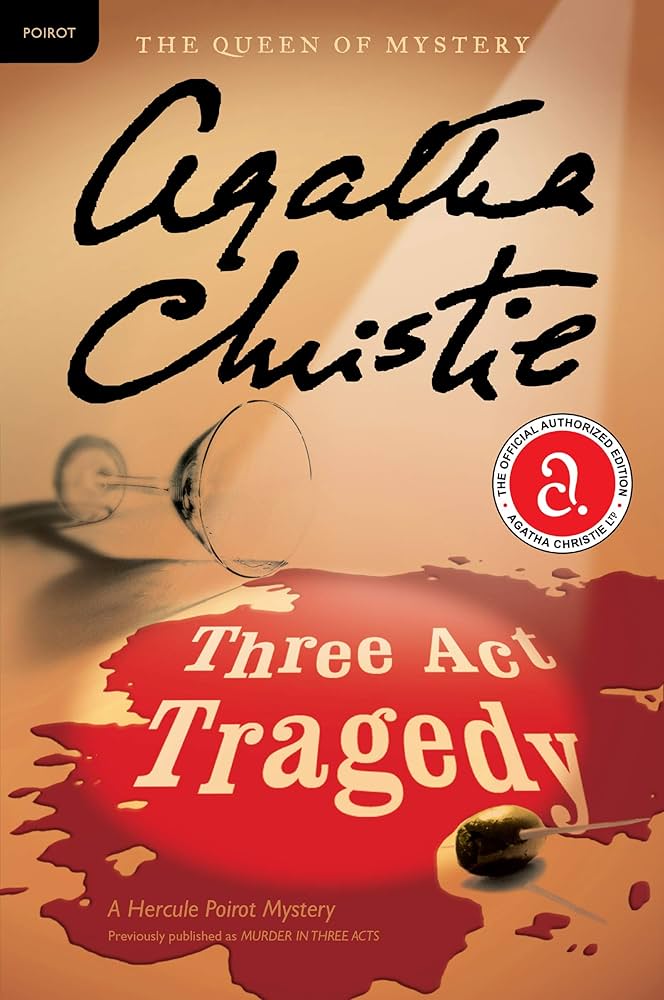
Three Act Tragedy
👤| Published | January 1935 |
| Genre | Detective Mystery |
| Publisher | Collins Crime Club |
| Language | English |
| Series | Hercule Poirot #11 |
📝My Honest Review: Three Act Tragedy
The setup here is fantastic. A group of people are at a dinner party hosted by a famous actor, Sir Charles Cartwright. A harmless, elderly clergyman sips a cocktail, falls over, and dies. No poison in the glass, no motive, no nothing. It’s an "impossible" death. But as the character "Egg" Lytton Gore points out:
"People like Mr. Babbington don't have enemies. That's the whole point. He was so—so—ordinary."
As a critic, I have to give Christie credit for the audacity of the twist. She uses the "theatrical" nature of the characters perfectly. But let's talk about the bad stuff. The motive for the first murder is genuinely one of the dumbest in the history of fiction. The killer basically performs a "test run" murder on a random person just to see if their method works. It’s cold-blooded, sure, but it feels like a very "lazy" way to write a plot.
Also, Hercule Poirot takes a backseat for a huge chunk of this book while Sir Charles and his friends play detective. If you like the "amateur sleuth" vibe, you’ll be fine, but if you want Poirot's genius on every page, you’re going to be waiting a while. It’s a clever puzzle, but the "human" logic behind it is pretty thin.
⏱️ 1-Minute Summary (for busy readers)
Rev. Stephen Babbington dies at Sir Charles Cartwright’s party after drinking a cocktail. Since no poison is found in his glass, it's ruled as natural causes. Later, at another party, Sir Bartholomew Strange dies the exact same way—but this time, nicotine is found. Hercule Poirot joins forces with Sir Charles and "Egg" Lytton Gore to investigate.
The twist is a masterclass in stagecraft. Sir Charles Cartwright is the killer. He wanted to marry Egg, but he was already secretly married to a woman in a mental asylum (back when you couldn't divorce them). He needed to kill Sir Bartholomew because the doctor knew about the secret marriage. He killed the clergyman at the first party just as a "dress rehearsal" to prove that he could swap a poisoned glass in front of everyone without being caught. He played the "detective" to keep himself close to the investigation.
🔹 The Critic's Report Card
| ⭐ Rating | 3.4 / 5 A 5-star trick buried in a 2-star story. |
|---|---|
| 👍 What I Loved | The "Invisible" Murder. The way the glass was swapped is so simple and clever that you'll feel like an idiot for missing it. |
| 👎 What I Didn’t Like | The Motive. Killing an innocent old man just to "practice" a murder is a bit of a stretch, even for a narcissistic actor. |
| 😐 Overrated or Underrated? | Slightly Overrated. People praise the twist, but the actual experience of reading it can be a bit of a chore. |
👤 Human Take: Life as a Stage
The "human" part of this book is the scary look at narcissism. Sir Charles is an actor who can't stop acting. To him, the people around him aren't real; they are just supporting cast members in the "Play of Charles." He doesn't feel bad about killing the clergyman because, in his mind, that man was just an extra on his stage. It’s a chilling reminder that some people are so full of themselves they lose their basic humanity.
The Final Word: Read it to see one of Christie's most famous tricks, but don't expect the characters or the motive to stay with you very long.
Discover Your Next Great Read
Handpicked recommendations from our collection of literary treasures
💬Discussions