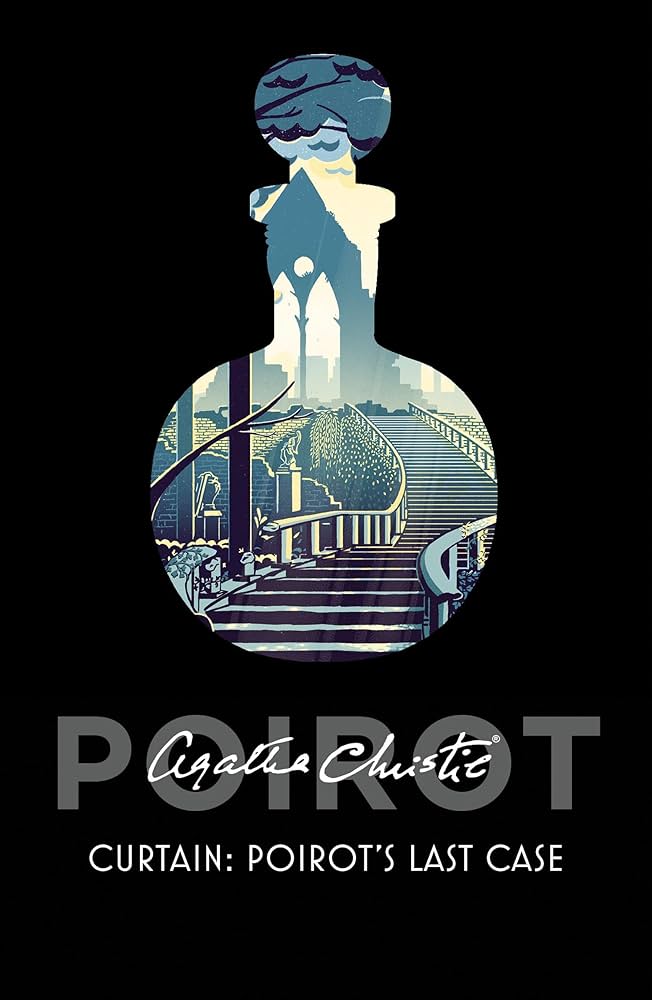
Curtain: Poirot's Last Case
👤| Published | September 1975 |
| Genre | Psychological Mystery |
| Publisher | Collins Crime Club |
| Language | English |
| Series | Hercule Poirot #33 (Final) |
📝My Honest Review: Curtain
This is the hardest Christie book to review because it feels so personal. We return to Styles—the setting of the very first Poirot book—but everything is different. Styles is decaying, Hastings is a widower, and Poirot is a ghost of his former self, confined to a wheelchair and dying of arthritis. It’s depressing as hell. Poirot tells Hastings:
"I am like a prima donna who makes a many farewell tours... but this, my friend, is the real farewell."
As a critic, I have to warn you: this isn't a fair-play mystery. You cannot solve this using the usual clues. It's a psychological battle against a "perfect" killer who never actually commits a crime with their own hands. The pacing is slow, heavy, and filled with a sense of unavoidable doom. Some might find the ending controversial or even "out of character" for Poirot, but it is undeniably powerful.
My only real "bad" critique is that Hastings is almost too stupid in this book. He misses obvious signs because he’s blinded by his emotions, and it can be frustrating to watch him stumble around while Poirot is literally at death's door. But that's the point—this book is about the frailty of humans and the limits of the law.
⏱️ 1-Minute Summary (for busy readers)
An aging, frail Poirot summons Hastings to Styles Court. He reveals there is a killer among the guests—someone he calls "X." X is a psychological mastermind who manipulates other people into committing murders, leaving X legally innocent. Poirot knows X is responsible for five previous deaths but has no evidence to stop them.
As deaths begin to happen at Styles, Poirot realizes the law cannot touch X. In a shocking final act, Hercule Poirot becomes the killer himself. He executes X (Stephen Norton) to prevent further tragedies, then stops taking his heart medication, effectively choosing to die. He leaves a letter for Hastings explaining that he had to "break the law" to protect the innocent. The book ends with the death of the world's greatest detective.
🔹 The Critic's Report Card
| ⭐ Rating | 4.9 / 5 A perfect, tragic ending to an legendary series. |
|---|---|
| 👍 What I Loved | The bravery of the ending. Christie had the guts to let her hero die and to let him fail his own moral code to save others. It’s incredibly human. |
| 👎 What I Didn’t Like | The depressing atmosphere. It’s a very "grey" book. If you’re looking for a mood-lifter, this is the exact opposite. |
| 😐 Overrated or Underrated? | Underrated. People avoid it because it's the "sad one," but it’s arguably her best written work since Roger Ackroyd. |
👤 Human Take: The Ultimate Sacrifice
The "human" core here is the love between Poirot and Hastings. Even at the very end, Poirot is protecting his "cher ami." He knows Hastings isn't strong enough to deal with a killer like X, so Poirot takes the sin of murder onto his own soul so Hastings can remain innocent. It’s a beautiful, tragic look at what happens when a brilliant mind is trapped in a failing body. It’s a reminder that even the strongest among us eventually have to face the "final curtain."
The Final Word: Have some tissues ready. This isn't just a book; it’s the end of an era. It’s brilliant, but it will leave a hole in your heart.
Discover Your Next Great Read
Handpicked recommendations from our collection of literary treasures
💬Discussions