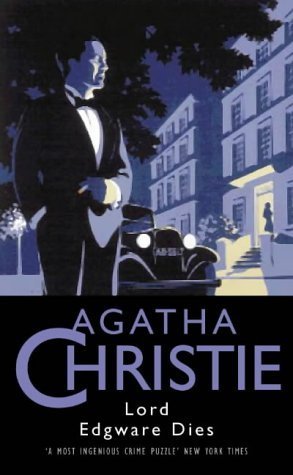
Lord Edgware Dies
👤| Published | September 1933 |
| Genre | Detective Mystery |
| Publisher | Collins Crime Club |
| Language | English |
| Series | Hercule Poirot #9 |
📝My Honest Review: Lord Edgware Dies
This book starts with a premise that is pure gold. A famous American actress, Jane Wilkinson, tells Poirot she wants to "get rid" of her husband, the cruel Lord Edgware. A few hours later, he’s found stabbed in the neck. The catch? Jane was seen entering his house by several witnesses, but at the exact same time, she was attending a high-society dinner party with a dozen other people. It's the ultimate "How can she be in two places at once?" mystery.
But let’s get into the "bad" stuff. The middle of this book feels like Poirot is just running in circles. There’s a sub-plot involving a golden pince-nez and a bunch of minor characters who are honestly quite forgettable. Compared to the high-stakes drama of the opening, the investigation gets bogged down in a lot of "theatre talk" and red herrings that feel a bit forced just to pad the page count.
Also, Poirot himself admits he was "fooled" for most of the book, which might frustrate fans who like him to be ten steps ahead. The solution is very theatrical—literally. If you aren't paying attention to the specific personalities of the characters, the twist might feel like it came out of nowhere. It's a solid 1930s mystery, but it doesn't quite hit the legendary status of Orient Express or Roger Ackroyd.
⏱️ 1-Minute Summary (for busy readers)
Jane Wilkinson wants a divorce from Lord Edgware to marry a wealthy Duke. When Edgware is found murdered, Jane is the obvious suspect, but her rock-solid alibi (a dinner party) makes the crime look impossible. Hercule Poirot investigates and discovers a second murder: an actress named Carlotta Adams, who died from an overdose of veronal.
Poirot eventually realizes that the "alibi" was the crime. Jane Wilkinson hired Carlotta Adams to impersonate her at the dinner party while Jane herself went and murdered her husband. Jane then killed Carlotta to keep her quiet. The "impossible" mystery was actually a very simple case of cold-blooded murder hidden behind a theatrical performance. Jane is arrested, still obsessed with her own fame until the very end.
🔹 The Critic's Report Card
| ⭐ Rating | 3.8 / 5 A brilliant hook, but the journey to the end is a bit bumpy. |
|---|---|
| 👍 What I Loved | The character of Jane Wilkinson. She’s a sociopath who is so charming and superficial that she almost gets away with murder because nobody thinks she’s smart enough to pull it off. |
| 👎 What I Didn’t Like | The pacing. There’s a long stretch in the middle where it feels like nothing is happening except Poirot being confused by a pair of glasses. |
| 😐 Overrated or Underrated? | Underrated. It’s often forgotten in the Poirot canon, but the central trick is actually very influential. |
👤 Human Take: The "Vain" Killer
The most interesting thing about this book isn't the clues—it's the personality of the killer. Christie shows us a person who is so self-centered that other people aren't even "real" to them. Jane Wilkinson doesn't kill out of hate; she kills because her husband is an "inconvenience" to her social climbing. It’s a chilling look at how vanity can turn into violence.
The Final Word: It’s a fun, glitzy mystery that captures the 1930s London theatre scene perfectly. Just be prepared for a bit of a slow-down in the middle before you get to the big reveal.
Discover Your Next Great Read
Handpicked recommendations from our collection of literary treasures


💬Discussions